The opportunity hiding in plain sight
LinkedIn's Services Marketplace had quietly become one of the largest freelance platforms in the world — bigger than Upwork and Fiverr combined, with 9 million service providers and 4.5 million active buyers per year. But it wasn't making money. And providers were getting just 0.4 Requests for Services per month on average.
Marketplace
9M
service providers — larger than Upwork and Fiverr
Active buyers
4.5M
per year with no efficient way to find the right provider
The gap
0.4
avg RFS per month per engaged provider

Research — competitors & current state
I evaluated the current request-for-services flow on competing platforms — Yelp, Upwork, and Thumbtack — to understand the patterns buyers and providers were already familiar with, and where LinkedIn had room to differentiate.

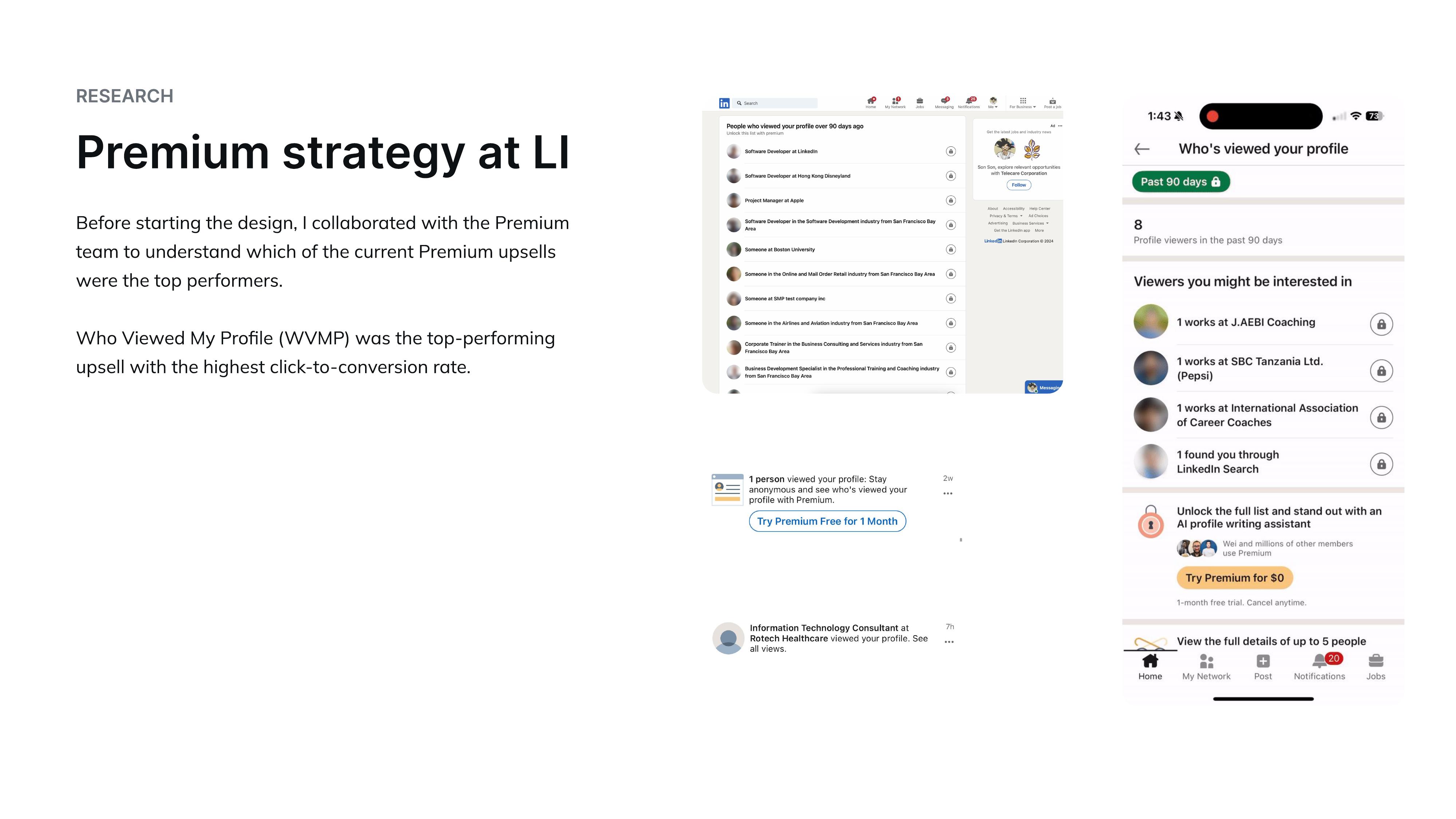
The insight — borrow from what already works
I collaborated with the Premium team to understand which existing upsells performed best. Who Viewed My Profile had the highest click-to-conversion rate — a clear, immediate value exchange. I applied the same model to Services.
Core mechanic
Buyers opt in to share their service request with multiple Premium providers. Providers subscribe to Premium to unlock those shared requests. Both sides benefit; neither feels coerced.
Proposed solution

A two-sided design problem
Buyer — Cheri
At the end of her 4-step request form, she sees an opt-in to share her project with multiple Premium providers. She gets 4–5 competitive proposals and picks the best fit.
Non-premium provider — Rose
Sees Cheri's request listed — but locked. "Premium providers receive 20x more requests on average." The locked state creates desire without deception. She upgrades.
Premium provider — Jeff
Because Cheri opted in, Jeff received her shared request alongside other Premium providers and can submit a proposal directly.
Cross-team collaboration
Service marketplace, Content Design, Premium, and COR (notifications and emails) all needed to be aligned. I designed email and push notifications alongside the core flows.
Design explorations
I explored multiple approaches to how Premium and direct requests could coexist in the provider admin view — testing different ways to signal value and trigger the upsell without feeling manipulative.

UI improvements
The existing requests page was updated to eliminate unnecessary elements and reduce visual clutter — creating a clear hierarchy between Premium and direct requests.

Before
Flat list, no hierarchy between request types. No Premium signal. Visual clutter throughout.
After
Clear Premium / Direct sections. Locked state communicates value. Cleaner information hierarchy.
Key user flows


Collaboration with other teams
This project required close alignment across Service marketplace, Content Design, Premium, and COR (notifications and emails) to ensure all touchpoints followed established LinkedIn patterns.

Expected impact
For providers
20–30×
more RFS per month for Premium subscribers
For buyers
5–10
competitive proposals per request
For LinkedIn
$4.8M
near-term · $170M annual long-term
projected Premium revenue impact